Happy Pride Month!
I find the idea of fandoms fascinating. Not only because when I was younger I found myself reading through instagram posts and drawing fanart, but because I think it’s something that could be studied the same way that we analyze classic literature. A lot of people know this story, but when Arthur Conan Doyle killed off Sherlock Holmes, members of the public wore black to mourn the fictional character. Fandom, now often online, is similar to me, and it’s immensely interesting to see how people interpret stories.
And since it’s Pride Month, I want to talk a little bit about the ever dreaded Queer Baiting. I’ve been there plenty of times as a teen, watching a show because I heard that it was a little gay or saw some clips that made two characters seem like they had tension, only to find out that they are absolutely meant to be straight.
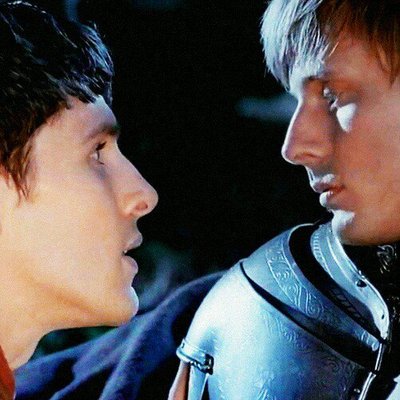
The first major show I noticed this in was Merlin (2012). It was a BBC show inspired by the tales of Arthurian legend, which I love and even took a class on in University. However, this love of Arthurian legends was only part of the reason I watched Merlin – the other was the amount of fanart, tumblr posts, and yes, even fanfiction and headcanons that told me that Arthur and Merlin were gay and in love. And I don’t want my words to be twisted; Fans watching a show and recommending it are not the instigators of Queer Baiting. That is solely on the writers. Merlin and Arthur do have tension in that show, and after reading many Arthurian Legends for my University course, many of the knights have tension with each other in the original texts, too. But the writers behind Merlin seemingly leaned into this relationship as the fandom began to grow. Seedlings of good chemistry between friends suddenly became amped up, and were borderline romantic. Many of Arthur’s actions towards Merlin were more caring than the way that he treated Guinevere. And while I was younger watching this, I didn’t pick up yet that this was likely intentional to build the audience.
And of course, we cannot forget about the lesbians! I was watching Supergirl (2015) as it aired, and watched as SuperCorp (Supergirl & Lena Luthor) became a common word in fandom spaces. I was slightly more involved in this cast than Merlin’s, mostly because I was older with this, but I was also getting into TV. I watched interviews with the cast, kept up with announcements, even dressed as Supergirl for Halloween that year. And something that shocked me at the time was an interview with the cast at a Convention (Maybe ComicCon but definitely something adjacent to it) where a fan asked about SuperCorp and the cast laughed dramatically and for a few minutes said “They’re just friends” over and over. And I don’t really blame them for this, either, but at the time, many people took offense to this. They didn’t write the show, but their acting and chemistry did influence the subtext between these characters as well. Watching this ripple through a fandom that had adopted SuperCorp as their thing was crazy as people became disappointed that the cast didn’t see their point of view.
I didn’t quite analyze this until I was taking a theory class in my English program and we talked about Reception Theory, which basically boils down to how the audience receives and interprets media. For example, if a book’s chapter ends with the characters getting in a car and the next chapter begins with the characters arriving at their locations, audiences would interpret that naturally and the characters driving to their destination. That’s a simple example, but we see it in cases of Queer Baiting where writers and creators of the show see this reception from audiences that start as a seed, and water it to become a tree.
I analyzed the book The Outsiders (1967) by S.E. Hinton. I learned a few years earlier that S.E. Hinton allegedly didn’t like the interpretation that fans had regarding the accusation that some of her characters were gay. A lot of people took offense to this, though I think the reaction to the question was more in play for that aspect. But my essay ended up being about Reception Theory and how once a piece of media is released into the public, it is almost no longer their authors. This is especially true for books, like in this case, where the public saw something that Hinton didn’t, and it grew.
But in the case of television, writers can either continue the narrative and play into it for their fandom without ever actually making them gay, or to overcorrect, like I think the Star Wars sequels attempted to do by giving Finn a romantic love interest to distract from his apparent chemistry with Poe Damaron. To me, it’s similar to writers that decide to change the ending of their shows because audiences predicted them. Why? Audiences can think what they want, so why change your original vision?
I do think that there’s been a slight shift, though. I haven’t watched 9-1-1 yet, but I do know that one half of a headcanoned ship came out as bisexual, leaving the door open to make that relationship canon in the future. Is this still bait? We won’t know until it becomes canon or the show ends. But I think at least having that real representation of a bi man is a step in the right direction, at least.
As writers, I think we need to be intentional with what we write, especially during times like these. There is a difference between slow burn and bait. If you value representation, make your characters actually LGBT+ instead of beating around the bush and Queer Baiting.
-Kait
 How We Write
Leave a comment